







Intensification of tropical cyclones: impact of fine scale processes
Atmospheric Sciences, Modeling
Research area
Predicting tropical cyclone (TC) intensity is still challenging. The Wind-Induced Surface Heat Exchange (WISHE) mechanism provides a framework for estimating TC maximum intensity, modeling intensification as a feedback between surface fluxes and wind speed, approximating TCs to a Carnot heat engine. This allows to estimate a maximum potential intensity (PI) based on boundary conditions: SST and upper tropospheric outflow temperature. High-resolution simulations and observations show deviations, including lower-than-PI intensities and intensity oscillations. These variations may result from cold SST patches, landfall, or vertical wind shear. Additionally, stratospheric interactions can induce upper-level warming by entraining buoyant air, potentially modifying intensification rates. This project explores the interplay between both air-sea fluxes and stratospheric interactions with TC intensification.
Project goals
The simulations will be carried out during April. Their design remains unchanged and consists of a set of idealized, doubly periodic simulations over an oceanic domain, with a Sea Surface Temperature (SST) field prescribed and fixed in time. The SST field includes spatial anomalies whose amplitude is progressively increased across the different simulations.
Computational approach
I need to retrieve, store and analyse large amounts of data, in the order of the Terabytes. When I'll work on simulations, I'll need to be able to run multiple simulations at high spatio-temporal resolution (km scale), to limit as much as possible using parametrisation while simulating convective processes.
Image
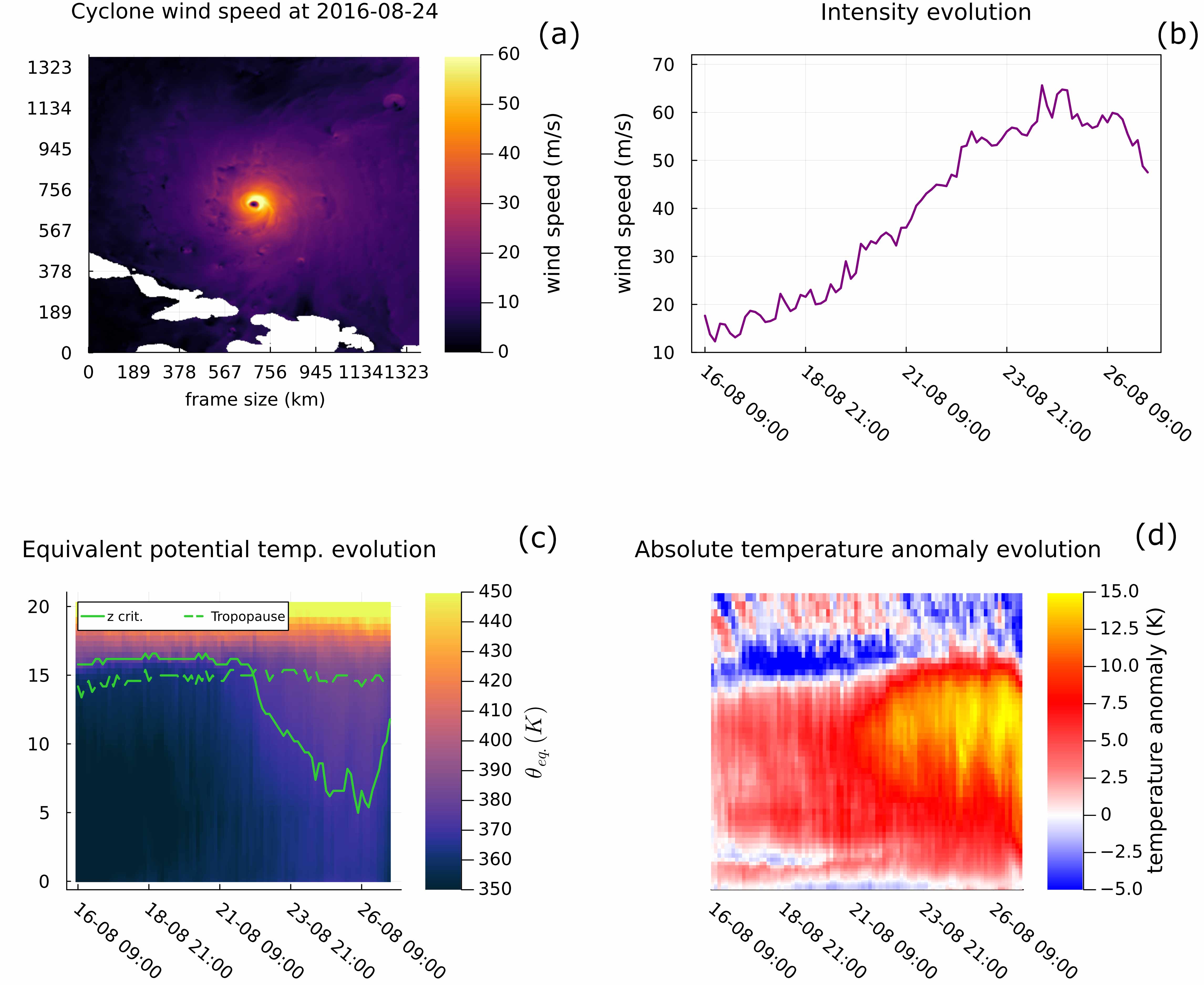
Simulation of a TC: (a) surface wind speed during intensification and (b) its intensity evolution. (c) Hovmoller plot showing the equivalent potential temperature in the core: this variable is conserved in convection, defining a threshold beyond which air can be considered of stratospheric origin. The height level at which this threshold is reached is "z crit" (solid line). (d) Core temperature anomaly with respect to pre-storm conditions, showing upper-level warming at the TC mature stage.
Key results
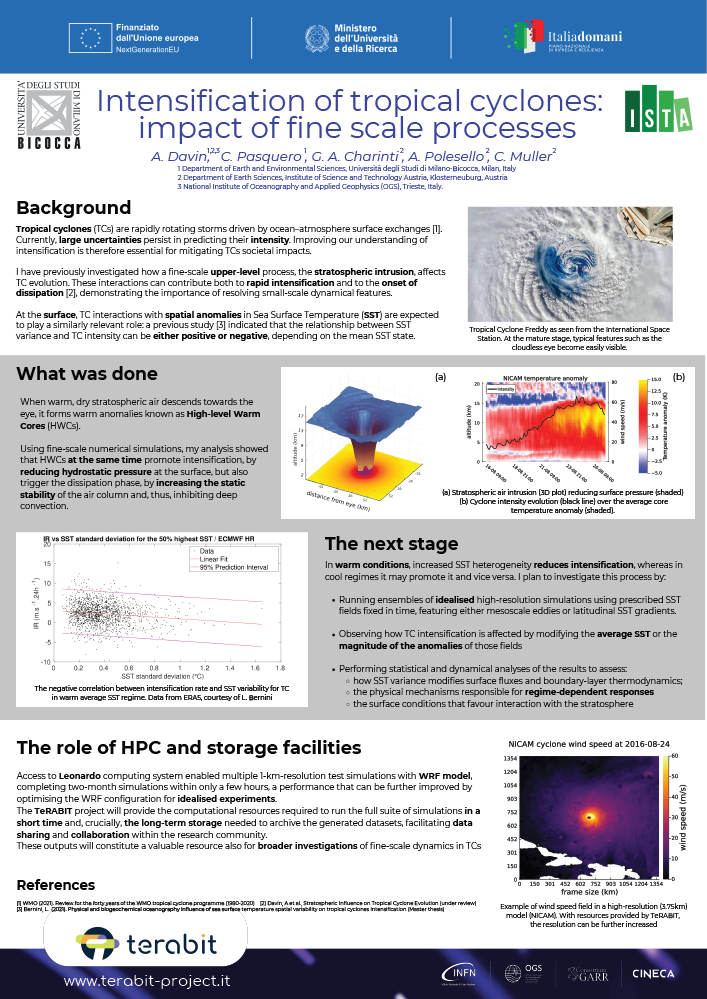
Thanks to the computational resources provided by the TeRABIT project, I was able to run a series of test simulations on the Leonardo HPC system to assess their feasibility and estimate the associated computational cost. With the experimental design now finalized, I am ready to investigate the role of sea surface temperature spatial variability in the intensification of tropical cyclones.
Resource usage
Up to now, I've only tested which is the optilmal configuration for my experimental design by running the same test simulation with an increasing number of CPUs
What's next
The TeRABIT project will provide the computational resources required to run the full suite of simulations within a short timeframe. Importantly, the long-term storage infrastructure will enable the archival of the generated datasets, thereby facilitating data sharing and collaboration within the research community.
Image
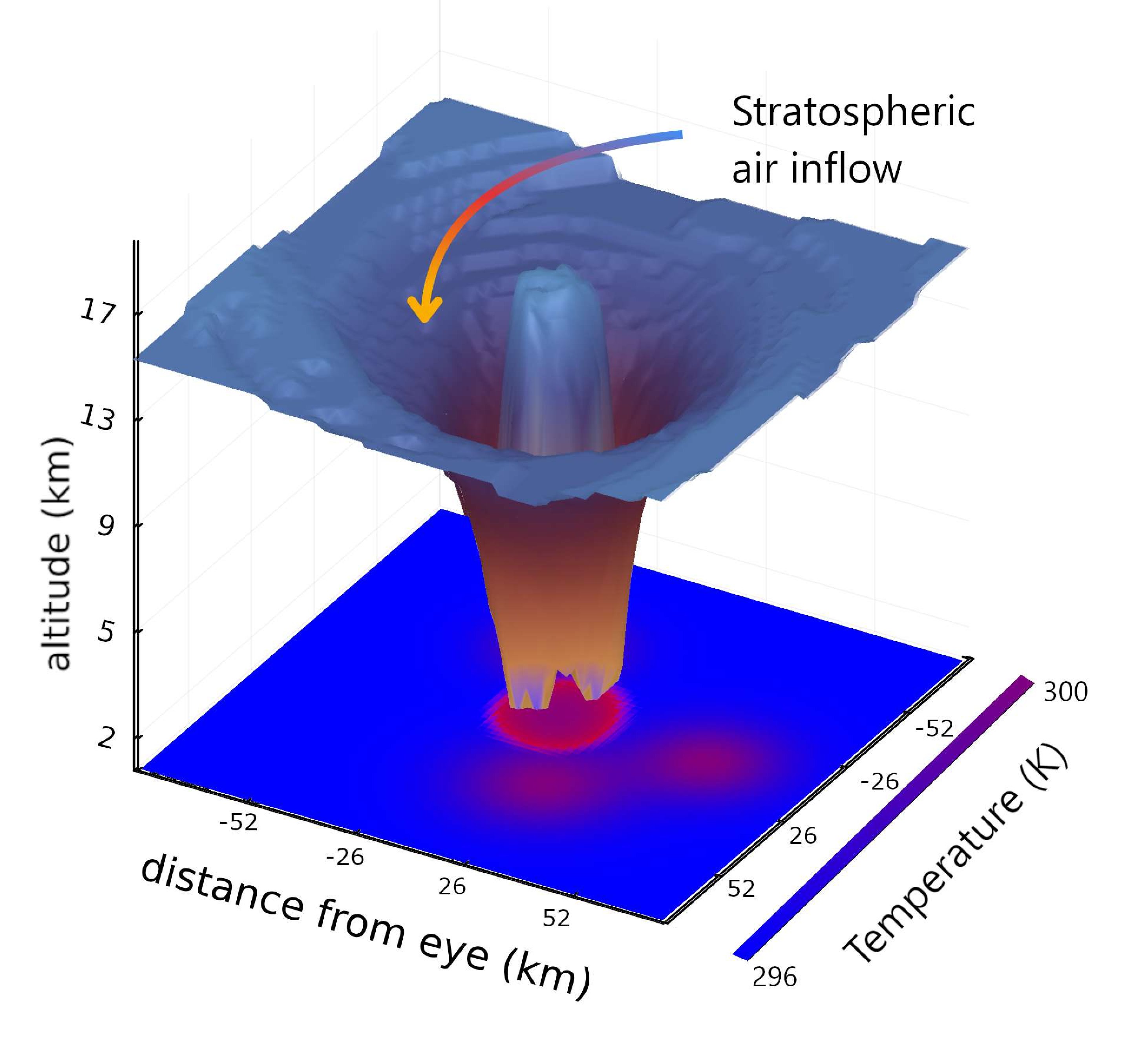
Mature stage of a simulated tropical cyclone. The intrusion of stratospheric air, the focus of the first part of this project, is highlighted by the 3D surface, which separates ait of stratospheric origin from the rest of the troposphere. At the base, the representation of a spatially non-uniform sea surface temperature field introduces the focus of the next phase of the project, to be carried out using computational resources provided by the TeRABIT project.
Andrea Davin
University of Milano-Bicocca
I hold a Bachelor's degree in Physics from the University of Milan-Bicocca (2017-2020) and a Master's degree in Physics of Complex Systems from the University of Turin (2020-2023, 110/110 cum laude), where I focused on mathematical modeling of vegetation pattern formation. As part of an Erasmus Traineeship at the Copernicus Institute of Sustainable Development (Apr.–Jun. 2023), I conducted a manipulative experiment on drought-induced vegetation patterns. Currently, I am a PhD student at the University of Milan-Bicocca, researching tropical cyclone intensification. I have also been a visiting student at IST Austria (Mar.–Jul. 2024). My main research interests include climate change and its impact on atmospheric and ecological systems.