







Development of an urgent high-performance computing framework for the rapid physics-based simulation of earthquake impact at regional scale
Solid Earth Sciences, Seismology
Research area
Earthquakes account for nearly half of natural disaster fatalities since 1980 (Munich Re 2024), driving advancements in disaster management. In response, the National Institute of Oceanography and Applied Geophysics (OGS) developed UrgentShake (Zuccolo et al. 2025), a system for near real-time physics-based ground shaking simulations in the Friuli Venezia Giulia region. Integrated with the Rapid Damage Scenario Assessment (RDSA) framework (Poggi et al. 2021), it estimates earthquake-induced building damage using ground motion data, fragility models, and exposure data. UrgentShake leverages high-performance computing (HPC) from the TeRABIT Project and the Python-based tool RAPIDS (Zuccolo, 2024) to automate input generation for simulation codes like SPEED, which models seismic wave propagation in large 3D portions of the Earth’s crust.
Project goals
My project focuses on SPEED (Mazzieri et al., 2013) within the UrgentShake workflow (Zuccolo et al., 2025), aiming to improve physics-based ground-motion simulations in a near–real-time earthquake impact assessment framework. A key objective is the development of an efficient mesh tessellation strategy, based on a precomputed regional mesh subdivided into validated subdomains, enabling dynamic selection and merging of the relevant computational domain according to earthquake parameters. This approach ensures compatibility with urgent-computing constraints while preserving simulation accuracy. In parallel, the project includes the development of a region-specific 3D velocity model for Friuli Venezia Giulia by integrating geological, geophysical, and geotechnical data. Finally, it supports the calibration of a regional empirical fragility model through large-scale simulations enabled by TeRABIT HPC resources.
Computational approach
The primary technological challenge lies in the development and implementation of the mesh tessellation strategy, ensuring that merging times improve its compatibility with urgent computing while maintaining the accuracy required for reliable damage scenarios. The process must efficiently handle dynamic subdomain selection based on earthquake parameters, minimizing computational overhead. Additionally, refining the model to better represent the complex geological and geotechnical conditions of the Friuli Venezia Giulia region will introduce greater mesh complexity and computational demands. A key challenge is to counterbalance the increased computational cost of these refinements without compromising simulation speed. Optimizing mesh generation, implementing parallel computing strategies, and leveraging high-performance computing (HPC) resources will be essential to ensure scalability and efficiency while maintaining the fidelity of ground shaking simulations.
Image
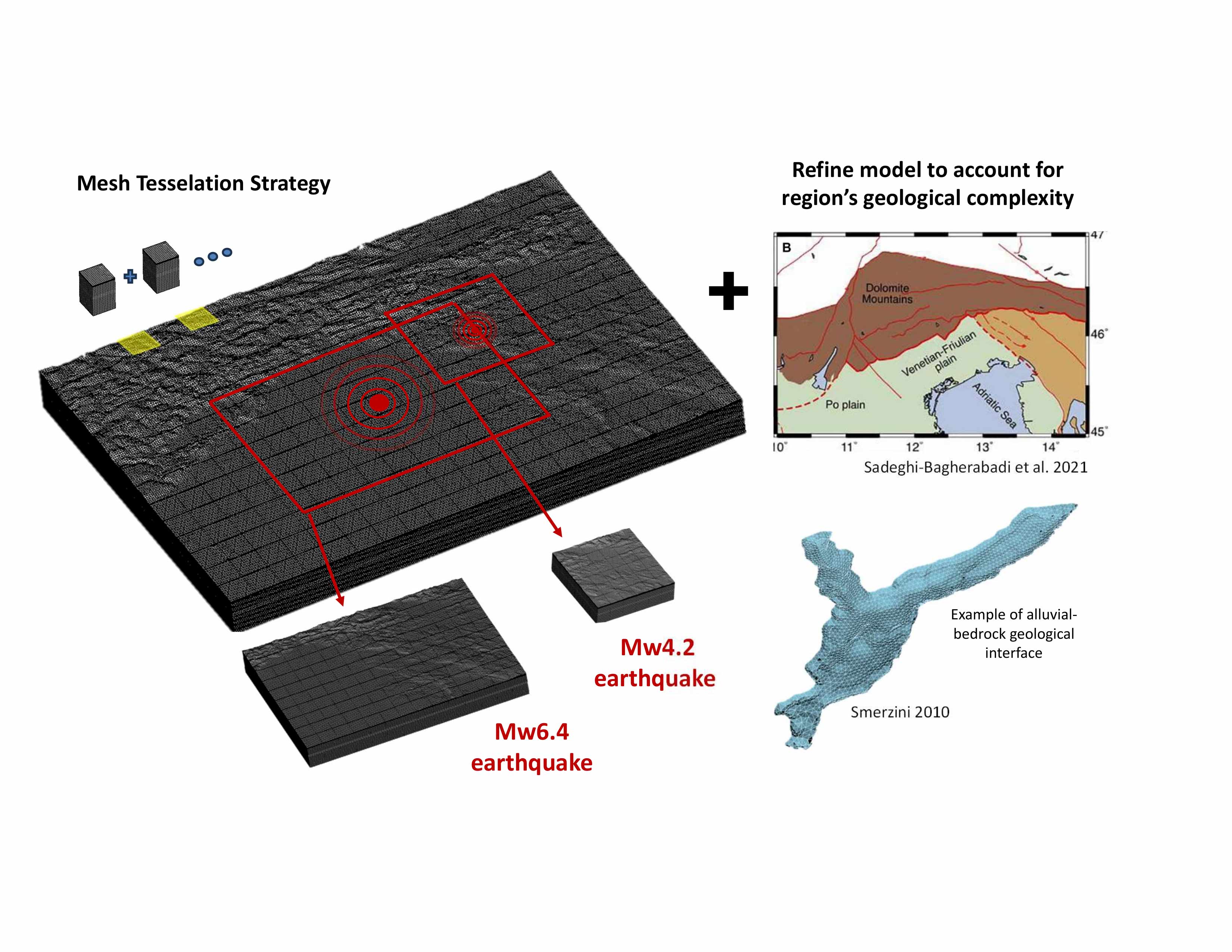
Technological challenges of the project: implementation of mesh tessellation strategy and improvement of the regional velocity model, improving compatibility with urgent computing.
Key results
The main achievement is the successful implementation and validation of the mesh tessellation strategy within the UrgentShake workflow. The approach enables dynamic selection and merging of precomputed subdomains, reducing SPEED model setup times from hours (up to >20 h) to minutes (down to seconds for smaller events), while preserving identical ground-motion results. This represents a key step toward operational urgent computing. A first version of a region-specific 3D velocity model has been developed through the integration of multiple datasets, including geological maps, crustal models, and a large set of geophysical surveys. Preliminary validation shows good agreement with observations, and further verification and sensitivity analyses are ongoing. The enhanced modelling approach (tessellated mesh and velocity model) has been integrated into RAPIDS, the Python-based tool used within UrgentShake for input preparation and post-processing, and successfully tested within the complete workflow. In addition, a preliminary empirical fragility model calibrated on the 1976 earthquake dataset has been developed using ground-motion scenarios generated with UrgentShake.
Resource usage
Although no dedicated TeRABIT allocation was requested directly within this activity, the project was carried out within the UrgentShake use case, which operates on the TeRABIT infrastructure. As a result, all major developments and applications benefited from these resources. In particular, TeRABIT HPC resources were used to perform large-scale physics-based simulations with SPEED, supporting the development and validation of the mesh tessellation strategy. These simulations were also essential for the verification and sensitivity analyses of the regional 3D velocity model. Furthermore, the computational resources enabled the generation of ground-motion scenarios required for the calibration of the empirical fragility model based on the 1976 earthquake dataset.
What's next
Future developments will focus on consolidating this work toward full operational readiness and scientific validation. The 3D velocity model will be further validated against recorded data and ground-motion models, including uncertainty and sensitivity analyses, to ensure robust regional applicability. The empirical fragility model will be validated against observed damage and tested for predictive capability across different seismic scenarios, enabling its integration into the regional near real-time damage assessment workflow (RDSA; Poggi et al., 2021), complementing current literature-based models. The contributions developed within UrgentShake will continue to be exploited by the scientific community.
Image
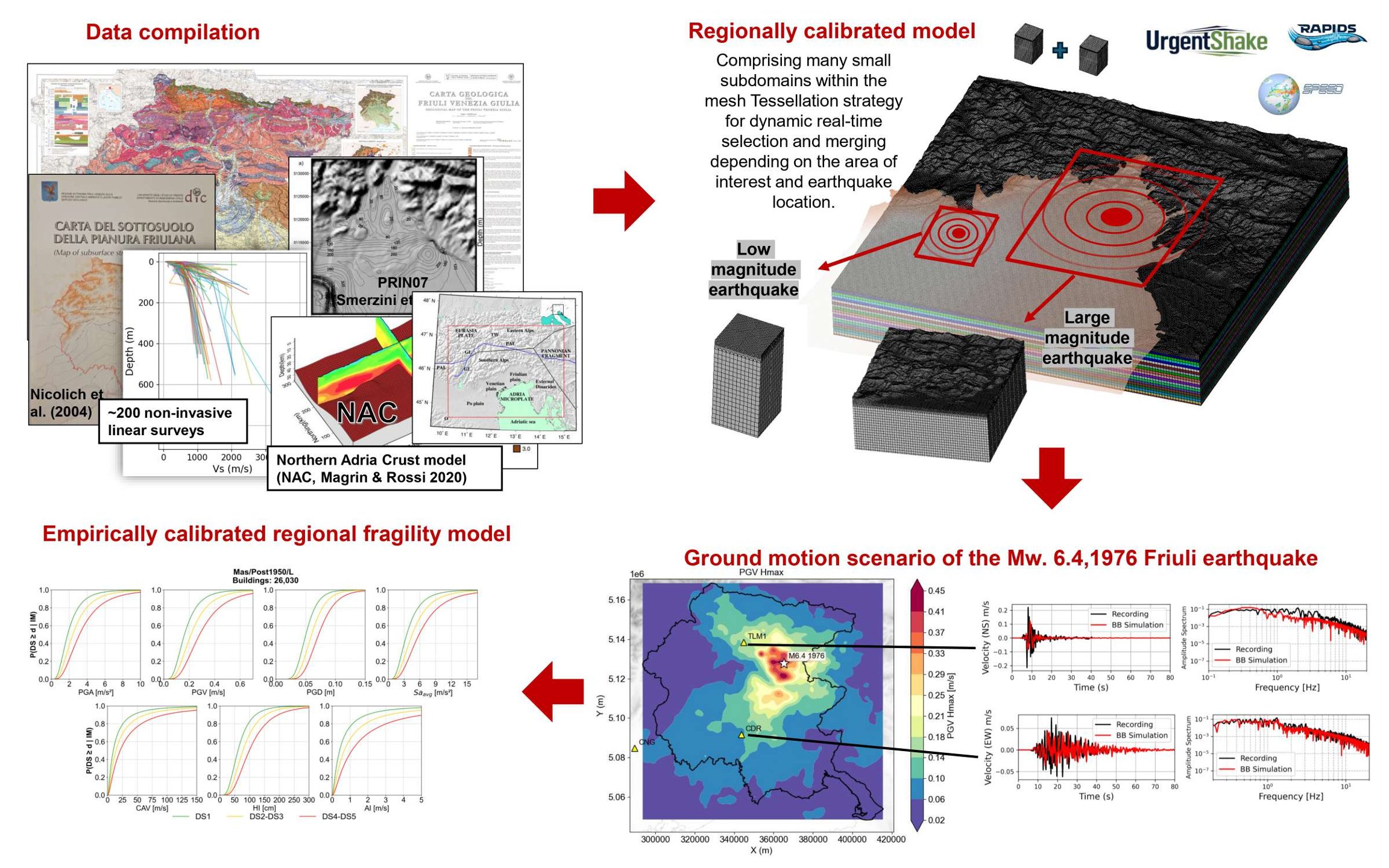
Overview of the work. A region-specific 3D velocity model is built by integrating geological and geophysical data. A mesh tessellation strategy based on precomputed subdomains enables dynamic domain selection and merging for efficient physics-based simulations. The workflow supports ground-motion scenarios and the calibration of a regional empirical fragility model.
Ileana Elizabeth Monsalvo Franco
Polytechnic University of Milan
My name is Ileana Elizabeth Monsalvo Franco, and I am a PhD candidate at Politecnico di Milano. I earned my bachelor’s degree in civil engineering from UNAM (Universidad Nacional Autónoma de México), Mexico, graduating in 2019 with a thesis on the feasibility of a new seismic energy dissipation system for Mexico City. In 2021, I began my master’s studies at Politecnico di Milano, where I specialized in earthquake engineering, earning my master’s degree in civil engineering in 2023. My master’s thesis focused on the calibration of seismic fragility curves using physics-based simulations. In early 2024, I started my PhD at Politecnico di Milano, which is currently ongoing.